Warehouse clearance in Utrecht: overview in your storage again
Old stock, discarded furniture and unused storage materials take up valuable space. Do you want to hand back a warehouse empty or only free up part of the storage? Ontruiming Utrecht helps with the agreed clearance and removal. We first map the contents, access and any dismantling.
Inventory surplus storage per zone
Clearly separate stock that stays from removal
Align carrying and transport with the quantity in advance
Smaller storage rooms or back rooms can be registered too
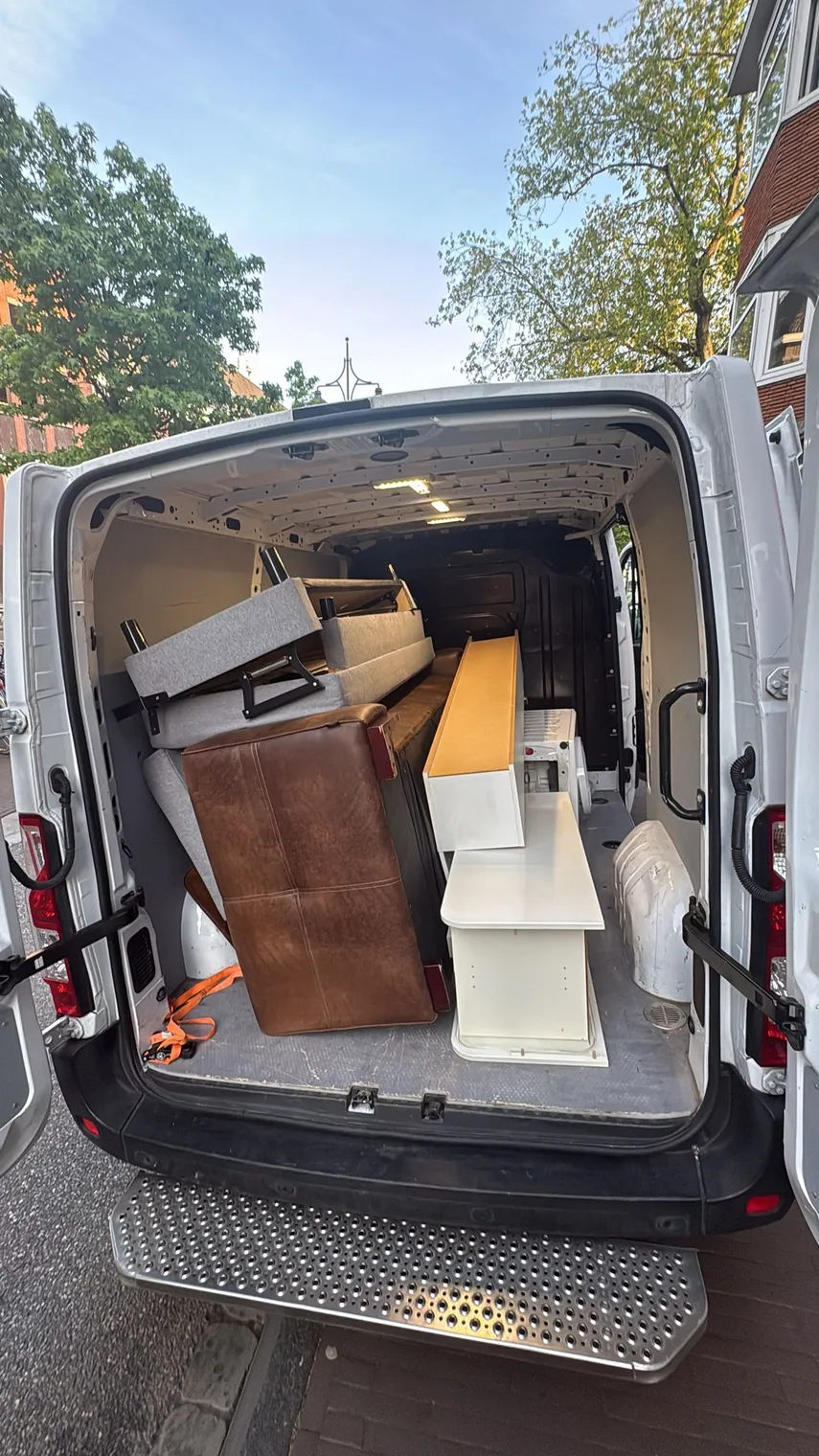
Furniture and loose parts together in the cargo area. Photo from the existing images on our website.
Calculate your collection price
Want to have furniture collected? Select the items you want removed below and enter the quantity. You will instantly see your collection price, including dismantling, carrying and disposal. Easily request your collection appointment and only pay once your furniture has been removed and you are satisfied.
Banken
Kasten
Bedden
Tafels
Stoelen
Witgoed
Tuin
Losse spullen
Deze categorie is momenteel leeg
Het lijkt erop dat we nog geen producten hebben toegevoegd. U kunt nu naar de homepagina gaan, maar zorg ervoor dat u later nog eens terugkomt!
Emptying a storage space takes more than counting boxes
In a warehouse it's not always immediately visible what can still be sold, what belongs to a customer and what may go. A good selection prevents useful stock from ending up with the removal. Make an overview per bay or zone and mark the items that fall outside the job.
Also show how heavy and large the items are. Loose boxes need a different approach than long workbenches, metal cabinets or fixed racks. High pallet racking, machines and unknown substances must be assessed separately; they don't automatically belong to a standard clearance.
Storage during a business move
Decide which stock goes to the new location. The surplus inventory can then be registered as a clearly defined removal job.
A full back room
A shop storeroom or storage room can also become usable again by having old furniture, packaging and loose items removed. Name the materials and quantities.
Handing back a warehouse
Share the landlord's requirements. Must only loose goods go, or also racks and fixings? Record the desired end state in advance.
Freeing up part of the storage
Mark per zone what may go and which aisles stay in use. A partial clearance prevents you from unnecessarily shutting down the whole business premises.
The benefits of a well-agreed warehouse clearance
Win back space
Remove what you no longer use, so the agreed zones become available for current stock, work space or handover.
Relieve your staff
The agreed lifting and transport is carried out without you having to organise separate removal trips yourself.
A selection that stays verifiable
A list per zone makes the job concrete. Your contact person can indicate what may go and which goods must stay untouched.
Insight into special points in advance
Dimensions, weight and photos help identify bottlenecks early. Necessary extra provisions can then be discussed first.
Emptying a warehouse in four clear steps
Take inventory of contents and materials Photograph every removal zone and state quantities, dimensions and known weights. List unknown or special contents separately.
Determine the work and loading route Show gates, doors, loading dock and any upper floors. Report rules for access and loading.
Confirm what will be removed Work with recognisable labels and one point of contact. Also record which dismantling and which handover result have been agreed.
Have it removed and check per zone After the work, you check the registered storage bays or rooms. With a full clearance, the agreed broom-clean handover is part of the finish.
What does a warehouse clearance cost?
Floor area says little without knowing what's on it. A large empty hall with a few cabinets is a different job than a small space full of heavy parts. Quantity, weight, material, dismantling and loading options determine the effort.
Also state whether the stock is packed, loosely stacked or spread across racks. Pass on the desired phasing if goods movements must continue. With that information, the proposal can match the actual situation.
Specialist storage needs a separate assessment
High racking, forklifts, heavy machines, chemicals, batteries and unknown liquids don't automatically fall under the removal. Report them in advance with photos and available information. First agree which processing and execution are possible.
Warehouse clearance at your Utrecht business location
For a warehouse at Lage Weide or a storage space elsewhere in Utrecht, access and loading are important. A wide gate only helps if it's also accessible on the day of the work. Arrange a contact person, any registration and a clear work route. For a location outside Utrecht, you can pass on your postcode and schedule.
A warehouse is meant to keep goods available, but in practice it also becomes the place where doubtful cases end up. Old product lines, returns, broken furniture and unused packaging stay because nobody makes a decision right away. In a clearance, that decision is exactly the starting point. Distinguish between current stock, goods with another destination and items that may be removed. The crew coming to clear can't tell from a box whether its contents are still intended for a customer.
So involve someone who knows the stock and the agreements with customers. Also check products that have been written off administratively but are still physically present. Conversely, goods without a clear label may still have a destination. Make the physical selection leading for the removal job and make sure it matches your own overview. Use a separate place for everything still in doubt. That way an unclear batch doesn't have to hold up the whole clearance and it stays visible which decision is still open.
For goods belonging to customers, suppliers or other branches, separately check who is responsible. Don't leave them among released removal items. The same applies to borrowed equipment and packaging that is being returned. A warehouse clearance is the execution of an agreed selection, not an assessment of ownership or commercial value. As soon as you know what may go, photos, quantities and material descriptions can be used to prepare the physical work. That turns an unclear collection of items into a concrete job.
Make your request recognisable per aisle, bay or storage zone
A large storage space becomes clearer when you describe it in small parts. For example, give the aisle, wall side or storage bay a name. First photograph the whole zone and then the special parts. Use the same name in the inventory list. That prevents different photos from unintentionally being counted as separate batches while they show the same items. A simple sketch can help if the layout isn't immediately clear from the photos. It doesn't have to be a technical drawing to still give useful information.
Describe what lies behind and under the visible inventory. With densely stacked storage, one photo often only shows the front row. Mention extra rows, loose parts and material on higher levels. State whether quantities have been counted or are still an estimate. A reliable description helps more than a seemingly exact number that later turns out to be wrong. You can simply name uncertainties. Then it's clear which part still needs sorting before a final execution can be agreed.
Update the list if stock is sold or moved in the meantime. Especially in an active warehouse, the situation can change within a few days. So appoint one person who monitors the removal zones and collects changes. Take photos as close as possible to the moment the inventory is settled. With a partial clearance, use visible boundaries between the work zone and storage that stays. The goal is that the list, the labels and the on-site instructions tell the same story when the work begins.
Removing racking starts with the contents and construction
Having individual racks and shelving units collected
Even if you only want a few racks removed, the request starts with an overview of the racks and their contents. A metal rack in a utility room, a wooden stock shelf behind a shop and a row of linked warehouse racks are different situations. Take photos of the front, the side and the fixings. State the height and width and how many bays or separate racks may go. That makes clear whether it's a limited collection job or a larger dismantling job.
Use one recognisable layout in your inventory. For example, count five complete racks with four shelves each, instead of just mentioning twenty shelves. Also say whether uprights are shared with a rack that must stay. That's important when you only want to remove part of a row of racking. Mark the part that may go on a photo, but always check together on site which parts belong to the agreement. The remaining storage must stay recognisably separate from the inventory to be removed.
Anyone looking to dispose of racking, remove storage racks or have warehouse shelving collected often has the same practical questions. Must the rack be empty beforehand? Which parts are fixed to the floor or wall? Is there enough room to take the construction apart? Discuss those points before you plan the work. Heavy pallet racking, mezzanine floors and constructions that are part of the building don't automatically fall under an ordinary furniture collection job. Have such situations assessed separately and record the work that can be carried out.
If the racks are in a garage or storage room at your home, you can combine the job with having other furniture collected. If several business premises are involved, also see having commercial property cleared. If there are desks or filing cabinets alongside the storage racks, the information about removing desks and office inventory helps you put together one complete list. A shared inventory prevents items from falling between two separate requests.
Don't start loosening loaded or unstable racks beforehand. Report damage, sagging shelves or missing parts in the request. Agree who moves the stock and when the relevant storage zone will be available. After the agreed racks have been removed, we check the freed-up space and the agreed handover together. Any repair of fixing points must be discussed separately; removing a rack is not a general agreement for floor or wall repair.
Racking is not the same as a loose cabinet. There are small shelves for manual storage, linked racks and tall systems for pallets. Name the type of racking, the dimensions and how it's fixed. Photos of the uprights, connections and any anchoring are useful here. Also mention what's still on the racking. The contents and the construction are separate parts of the request. An empty rack may be assessed differently than the same rack full of unknown materials.
Don't start loosening load-bearing or anchored parts yourself to make the request seem simpler. First have the right approach for the construction assessed. High pallet racking and special storage installations don't automatically fall within a standard removal job. We discuss in advance whether and under what conditions the desired dismantling is possible. If a specialist is needed, the order must fit in with the rest of the clearance. Clear boundaries prevent equipment or work from being expected that hasn't been agreed.
State what must happen to the loose parts. Will the racking stay available for a new user, be rebuilt elsewhere, or must the agreed parts be removed? That difference affects how you select and hand over the inventory. With reuse, also record who receives the parts. A removal job is not automatically an assembly job at another location. For a warehouse that belongs to a larger building, you can describe the connection with commercial property clearance in Utrecht.
Clearly describing boxes, pallets and loose materials
The number of boxes only gives useful information when the size and contents are also known. Ten boxes of light packaging material are different from ten boxes of heavy metal parts. State the known contents and say so if weight or material is unknown. Show whether boxes are closed, damaged or stacked on top of each other. A good description makes it possible to assess the request based on the actual situation. Don't silently assume everything is light because the outside looks the same.
Pallets can also have different roles. Some carry stock going to another branch, others are empty or intended for return. Make that selection in advance. State whether goods stay on pallets and which equipment is available on site. The presence of a pallet truck or forklift doesn't automatically mean it can be used without agreement. Coordinate access, operation and responsibilities with the warehouse manager. Describe what's possible without assuming that every piece of equipment is part of our work.
Gather small loose parts in a way that keeps the selection clear, without mixing different unknown materials. Label containers that stay and mention sharp, heavy or unusual contents. Paint, oil, batteries, liquids and unknown substances belong separately in the request. Such materials aren't automatically included when removing warehouse inventory. First have the required processing determined. A clear list of materials prevents it only becoming clear on arrival that the agreed removal doesn't match the contents present.
Freeing up a warehouse while logistics continue
In an active warehouse, staff sometimes need to keep picking orders, receiving goods or processing returns. Discuss which activities continue during the clearance and which aisles are needed for them. A partial clearance requires a recognisable boundary between the removal zone and daily work. It's not enough to just point out a corner when vehicles and goods have to pass through that same corner. Make a workable order together with your internal contact person and have the desired phasing assessed for feasibility.
Plan deliveries and removal so they hinder each other as little as possible. If a loading dock is only available briefly, that must be known in advance. Also mention peak moments in the flow of goods and agreements with carriers. A preference for a quiet moment helps with coordination, but the date and time slot of the work only become final after confirmation. Coordinate any changes in good time. After all, a warehouse that's empty on paper but full of new deliveries on arrival calls for a different organisation.
Inform your own staff about the released zones. Let them know who can approve changes and where items that are kept must be placed. Prevent an emptied zone from immediately being filled again before the final check has been done. With work in several phases, record per phase what has been completed. That keeps visible which parts are still to come, and those involved can plan their work around it. The physical emptying thus gets a clear place among the other logistics activities.
From the back storage bay to an accessible loading spot
The removal route starts where the items are, not at the front door. A warehouse can have a wide overhead door and still be hard to reach because of full aisles or an internal door. Describe the whole route the inventory must take. Mention thresholds, height differences and places where long parts have to turn. For a storage space on an upper floor, information about stairs or a goods lift belongs too. The more visible the route, the more targeted the work can be discussed in advance.
Let us know whether the loading point is right next to the exit or on the other side of a shared site. Barriers, access codes and limited opening hours are practical details that may affect the schedule. Make sure an authorised contact person can provide access at the agreed time. Only share what's needed to organise the work and discuss how access will be arranged on the day itself. An address without explanation is sometimes not enough for a large multi-tenant business building with several entrances.
For a storage location at Lage Weide or elsewhere in Utrecht, we base the preparation on the actual situation of your premises. You can also register a warehouse in the surrounding area with address and postcode. Read more about our services in, for example, Maarssen or Woerden. With several storage locations, state which inventory is where. That prevents confusion between the head office, an external warehouse and the address where the items actually need to be collected.
A back room or small storage space needs a plan too
Not every warehouse clearance is about a large business hall. A shop may have a back room that's no longer usable because of old displays and packaging. An office may store spare furniture in a locked room. In such a small space, inventory is often packed closely, making it hard to see exactly what's there. Start with photos of the accessible sides and describe what stands further back. Make clear whether the whole storage space must be emptied or only a selected quantity.
In a small storage space, furniture and ordinary inventory may form most of the job. Use the calculator at the top for items you recognise in the selection. Pass on additional items separately. A price for a few chosen pieces of furniture doesn't automatically cover all the boxes, racks or materials present alongside them. So it's wise to describe the complete removal request in one go. Via calculate your collection price you can view your furniture selection and start the request.
If the storage is part of an office move, also see the information about office clearance. There you'll find points of attention for workstations and filing cabinets that sometimes also end up in a warehouse. By taking inventory of the different rooms together, you prevent the same items from being listed twice or being forgotten. A small warehouse becomes clearer as soon as it's clear what function the space will have and which inventory actually needs to disappear for that.
Carefully completing a full warehouse handover
Record in advance what you mean by an empty warehouse. Must only the goods be removed, or also agreed racks, workbenches and other inventory? What belongs to the landlord and which facilities must remain available? With a full clearance, we hand over the space broom-clean as agreed: the agreed inventory is gone and the floor has been swept. That's separate from, for example, intensive floor cleaning, repair work or removing technical installations. Name additional handover requirements before the work is scheduled.
For the final check, use the same zones as in the request. Check per aisle or room what has been removed and which inventory has deliberately stayed. Also look at loose parts that may remain after dismantling and include them in the agreed check. If another party will carry out work later, note which parts fall outside this job. That keeps the distinction between the completed removal work and the overall preparation of the building for the next user.
A clear finish starts with a complete request. Send photos of the storage, a description of the materials, information about the loading route and your preferred date. State which selection still needs to be made and which work you expect. Via contact with Ontruiming Utrecht you can explain the special points. After coordination, you know what will be carried out and which preparation is still needed. You get the agreed storage space back and don't have to organise the heavy carrying and removal work yourself.
Answers for your request
Frequently asked questions about emptying warehouses and storage
Our warehouse is full of old stuff. Where do we start?
First distinguish between active stock, third-party property and items that may go. Photograph the removal zones and note large or heavy parts. That forms the basis for a targeted request.
Can you empty just one warehouse bay?
Yes, a clearly defined zone can be registered. Mark the boundary clearly and state which adjacent stock stays. That keeps the selection recognisable during the work.
Do you take old stock?
Describe what kind of products they are, how much there is and how they're packed. Not every type of stock fits within ordinary inventory removal. The contents and processing must be clear in advance.
Can metal storage racks be removed?
Send photos of the height, construction and fixing. Small loose racks differ greatly from professional pallet racking. Dismantling is only carried out as assessed and agreed in advance.
Is high pallet racking dismantled as standard?
No, don't assume that as standard. Height, fixing, load and necessary provisions require a separate assessment. Present the construction and desired work with the request.
Can pallets and packaging material go too?
Report material, quantities and condition separately. Wooden pallets, plastic crates and cardboard boxes are different waste streams. First have it confirmed what can be taken in your job.
Can normal warehouse activity continue?
State which zones and routes stay operational. We discuss a possible order and the boundaries of the work space. Coordination with your own staff remains important here.
Do we need to provide a forklift ourselves?
Don't arrange equipment based on assumptions. Pass on weights and loading facilities, and the required execution will be discussed. The use of specialist equipment requires separate agreements.
What if the weight of an object is unknown?
Send dimensions, material and photos, and look up type details if possible. Report that the weight is unknown. Heavy parts must be assessed before transport is promised.
Can machines be taken?
Report machines separately from ordinary inventory. Connections, weight and specialist dismantling can be decisive. The options are discussed separately.
Do you take oil, paint or chemicals?
These materials don't automatically belong to standard removal. State the packaging, contents and quantity. Unknown substances must first be identified and properly assessed.
Can a warehouse be handed over broom-clean?
With a full clearance, the agreed items are removed and the floor swept. Removing oil stains, repair work or specialist cleaning is a different question that must be discussed in advance.
What do we do with customers' goods?
Keep customers' property recognisably outside the removal zone. Only have items removed for which the right permission and instruction exist. Avoid mixed piles without a clear owner.
How long does a warehouse clearance take?
The time depends on the quantity, accessibility and dismantling. Photos per zone and information about loading options help make a realistic schedule. The square metres alone are not enough.
Can the clearance be carried out in phases?
Pass on the desired zones, order and deadlines. We assess whether that phasing is feasible. Each phase must clearly describe what will be removed and which space will be available.
What do I send for a price proposal?
Overview photos, types of material, quantities and large dimensions, plus loading route and postcode. Name special substances, machines and racks separately and state your preferred handover date.
Make your storage usable again
Show the removal zones and tell us what may go. We discuss the quantity, access and schedule for your warehouse or storage space.
Furniture collection and home clearance in Utrecht and nearby towns. From a single item to a complete home or business premises, with careful handling, clear agreements and a quote beforehand.
Furniture collection and home clearance in Utrecht and nearby towns. From a single item to a complete home or business premises, with careful handling, clear agreements and a quote beforehand.