The lease is ending, your business is moving or room is needed for a new layout. But where do all the desks, cabinets, workbenches and leftover inventory go? Ontruiming Utrecht helps empty your business premises, with an agreed schedule and a clear price for the work. You keep the overview; we take over the hauling and removal.
From one business unit to a complete building
Dismantling, carrying and removal in one agreed job
Clear in advance which inventory goes and what stays
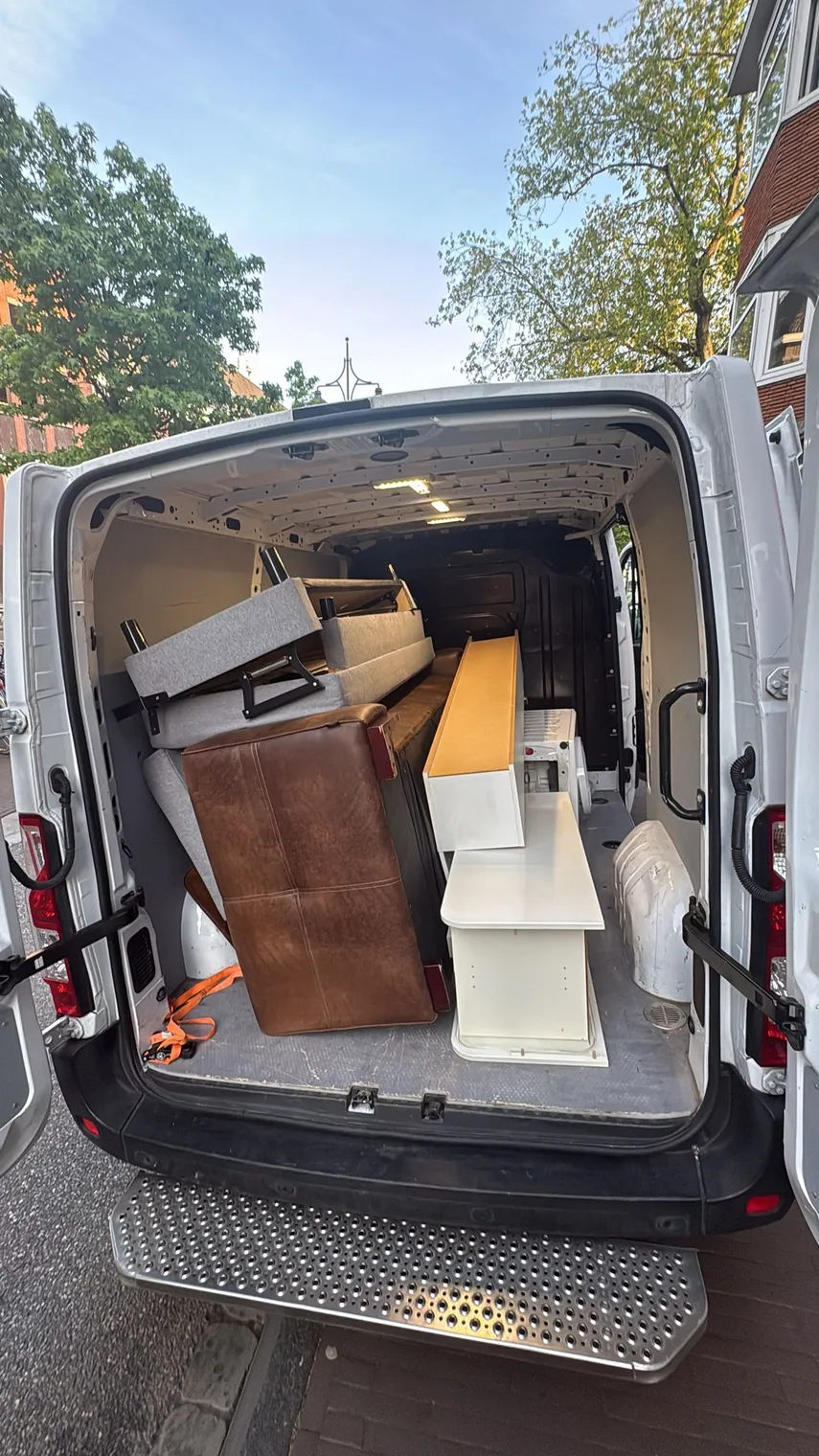
Furniture and loose parts together in the cargo area. Photo from the existing images on our website.
Calculate your collection price
Want to have furniture collected? Select the items you want removed below and enter the quantity. You will instantly see your collection price, including dismantling, carrying and disposal. Easily request your collection appointment and only pay once your furniture has been removed and you are satisfied.
Banken
Kasten
Bedden
Tafels
Stoelen
Witgoed
Tuin
Losse spullen
Deze categorie is momenteel leeg
Het lijkt erop dat we nog geen producten hebben toegevoegd. U kunt nu naar de homepagina gaan, maar zorg ervoor dat u later nog eens terugkomt!
Your business premises empty, ready for the next step
A business clearance isn't just about removing things. You want to be able to hand over the key, let staff keep working or prevent old inventory from holding up the move. That's why we start with your desired end result: which rooms must be empty, by what date and according to which handover requirements?
A shop space needs different preparation than a practice, workshop or building with several departments. We look at the amount of inventory, the route out and any dismantling. Also name what belongs to the landlord or a leasing company. That keeps the job clear for everyone with access to the building.
Business move
Have leftover furniture removed while you organise the furnishing of the new location. Separately show what moves, what stays and what may go.
End of lease or closure
Work towards an empty business space on the agreed date. Share the handover report or your landlord's requirements, so it's clear which work is needed.
Shop, practice or showroom
Counters, loose shelving, waiting room chairs and display furniture can be part of the request. We assess fixed installations and special equipment separately.
Partial emptying
A full storage room, old canteen furniture or unused department doesn't have to stay. You can also discuss a job for a clearly defined part of your building.
Why leave your business clearance to Ontruiming Utrecht?
One appointment for the physical work
You don't have to free up your own staff to haul heavy cabinets or plan several trips with a rented van. We take care of the agreed dismantling, lifting and removal.
Control over scope and price
Photos, quantities and information about access form the basis of the proposal. Report extra items before the work, so the agreed price fits the actual job.
Attention to what must stay
A clear selection prevents confusion about landlord property, leased equipment or inventory for the new location. We take what belongs to the job.
A concrete handover moment
A clearance becomes easier to organise when the contact person, access and final check are settled in advance. Report your deadline right away; the date of the work is confirmed after coordination.
How we prepare your business clearance
Map the inventory Send overview photos per room, quantities of large furniture, the address and the final handover date. Also photograph doors, the goods lift and the loading spot.
Coordinate work and schedule We discuss which parts will be dismantled, which rooms must be empty and whether phased execution is needed. Special materials get a separate assessment.
Make the work route available Inform staff and the building manager. Arrange access to gates and lifts and label the inventory that must stay.
Have the agreed inventory removed We take over the physical removal work. When finishing, check whether the agreed rooms are empty and, with a full clearance, broom-clean.
What does a commercial property clearance cost?
A small office with loose desks isn't comparable with a business hall full of heavy inventory. The costs depend on things like volume, weight, dismantling, floors and the distance between the building and the loading spot. The number of phases and special disposal also need attention.
So request a proposal for your actual situation. Send one complete inventory list rather than separate additions just before the appointment. For a few pieces of furniture, you can calculate the collection price; for a complete building we tailor the scope and execution personally.
Empty and broom-clean is a clear agreement
Broom-clean means the agreed inventory has been removed and the floor has been swept. Removing floor coverings, painting, repairing fixing holes, specialist cleaning and dismantling installations aren't automatically included. Present additional handover requirements in advance.
Clearing business space at your location in Utrecht
For a building at Lage Weide, Papendorp or another Utrecht business location, access rules often determine the schedule. Pass on loading times, barriers, parking space and the availability of a goods lift. You can also submit a request with your postcode outside Utrecht.
A clear inventory of your entire business premises
Business premises grow along with the work done there. Over the years, extra cabinets, spare chairs, packaging and display materials are added. On leaving, more is often left behind than is visible at first glance. So don't just walk through the main work area, but also open storage rooms, cupboards under stairs and locked rooms. Include the canteen, entrance hall and any upper floor in your overview. A complete inventory makes it easier to make a suitable request and prevents a forgotten room from only standing out at the final check.
Work per room with three clear categories: keep, hand over and remove. Items to keep go to the new branch, for example. Inventory to hand over may be intended for the landlord, a next tenant or another department. The third category forms the basis of our job. Give each room a recognisable name or number and use the same label in the photos. That way nobody has to guess during the work which cabinet a description refers to. A simple overview on paper is often enough, as long as the selection is current and clear to your contact person.
Also distinguish between loose furniture and parts fixed to the building. A freestanding workbench is different from a mounted counter with cabling. For fixed fittings, we want to know how they're attached and whether connections are present. Also let us know when you're unsure who owns a part. The goal is that you know in advance what belongs to the agreed clearance. You don't have to be able to assess all technical details yourself; clear photos and an honest description help ask the right questions.
Moving, refurbishing or closing: match the order to your situation
During a business move, different tasks run alongside each other. New furniture is delivered, staff pack their belongings and inventory must disappear from the old location. Choose a logical order, with furniture for the new branch set aside or moved first. Then the remaining inventory can be removed. That prevents a desk that's still needed from ending up with the removal. Also discuss whether the new tenant gets access before your own move is complete. Clear access moments keep the work organised.
During refurbishment, the building stays in use. Then boundaries per department are often more important than a fully empty building. State which work zones are available and where people still need to work. A meeting room can be emptied first, for example, while reception stays accessible. If phased execution is desired, we discuss the practical options and consequences for the schedule in advance. A phase is a concretely agreed part of the work, with its own items and access. Just saying everything must happen in between gives too little to go on.
When a business closes, more time may be needed for decisions about ownership, sale and transfer. Settle those choices as much as possible before the clearance begins. Make sure an authorised contact person knows what may actually be taken and that agreements with other parties have been processed. We can organise the physical emptying based on your instructions, but don't decide on behalf of various owners which inventory belongs to whom. A clear selection brings calm at a time when you already have a lot to arrange.
Different business spaces under one roof
A building with a showroom, office and storage calls for more than one general description. The showroom may have large display units, while the office mainly contains desks and chairs. At the back there may be boxes, loose shelving and unused materials. Mention those differences in your request. That gives us a better picture of the quantity, carrying routes and required dismantling. Photos from several angles are more useful than just a close-up of one piece of furniture. Also show how parts stand in relation to doors and corridors.
For a space with mainly workstations, you'll find additional preparation under office clearance in Utrecht. There, personal workstations, meeting furniture and the separation between furniture and IT play a role, among other things. If a large part of your building consists of storage, also see the information about having a warehouse emptied. Stock selection and assessing racking require different preparation than collecting loose business furniture. You can describe both parts in one request, so the connection stays clear.
A small practice, studio or shop can also have business inventory removed. Think of waiting room chairs, a loose counter or cabinets with materials that have already been sorted. Always describe special equipment separately. The same applies to heavy workbenches or furniture that is hard to carry because of its shape. A small floor area doesn't automatically mean the job is simple. The available space to turn, lift and dismantle partly determines how the work can be done.
Accessibility: from the last room to the loading spot
In the preparation, we look at the whole route the inventory takes. A building may have a wide entrance door, but a narrow corridor or sharp bend behind it. Pass on such points in advance. For upper floors, state whether a lift is available and whether large furniture parts fit in it. A lift used by other tenants may need to be available at an agreed time. Coordinate that with the building manager. Don't make assumptions based only on the fact that the building has a lift.
The distance from the exit to where loading is possible also counts. Think of an inner courtyard, a back entrance, a locked gate or a loading area shared by several businesses. Describe where the van can stand and when that spot is accessible. You don't have to create a special situation if there isn't one; just report what you know. If access hasn't been arranged yet, that's relevant information for the schedule. Timely coordination prevents waiting at a closed gate.
For a location in Utrecht or surrounding towns, you can send the address and postcode right away. If your organisation has several branches, clearly state which location is being cleared. A correspondence address isn't always the work address. For local information, also see clearance and furniture collection in Utrecht or the page for Nieuwegein. We base the final agreement on the actual location, inventory and access, so your request doesn't rest on an incomplete picture.
Preparing your staff for clearance day
A short internal explanation prevents a lot of confusion. Tell staff which rooms are up, when items must be available and who answers questions. Have staff take personal belongings out of desks and cabinets. Also think of small items out of sight, such as chargers in drawers, keys in a cabinet door and documents behind a drawer unit. The clearance crew must be able to rely on the agreed selection. A piece of furniture with unclear contents can cause delay because someone first has to decide what happens to it.
Appoint one contact person who knows about the job. This person doesn't have to move every piece of furniture, but must be able to clarify choices. Agree who stands in when that contact person is temporarily absent. In a building with several departments, it's wise to collect changes centrally. That prevents different staff from giving conflicting instructions. An additional cabinet can often be discussed, but must first be included in the agreements before anyone assumes it will automatically be taken.
Keep walking routes clear of loose boxes, roll containers and materials that don't belong to the clearance. Don't use corridors at the last moment as temporary storage for items that are being kept. Even when only part of the building is emptied, a clear work route helps work carefully. Discuss in advance whether visitors, deliveries or other work are scheduled. With that information, it can be agreed how the clearance fits in with the daily activities in the building.
A price request that matches the actual work
The calculator above this text is handy for furniture you find in the selection. Choose the matching type and the right number, so you get insight into the collection price for that selection. A complete business clearance may also include work that isn't listed as standard furniture in the calculator. Think of extensive dismantling, special inventory or several phases of work. Send additional information for that. The amount shown for a few pieces of furniture is not automatically a total price for all work in a complete business building.
A useful request contains overview photos, an inventory list, the work address, information about floors and your preferred date. Add the handover requirements if they're already known. Explicitly state which work you expect regarding floor coverings, fixed parts or extra cleaning. That way the proposal can be based on the same assumptions as your own planning. Then compare proposals on the described work, not just on one total amount. After all, differences in content can also explain differences in price.
For a small removal job, you can directly calculate your collection price and submit a request. For a building with varied inventory, you can explain the situation via contact with Ontruiming Utrecht . Mention it when not everything has been sorted yet. Then it's clear that quantities may change. An agreed price and schedule are most useful when they match the amount of items actually ready to be removed on the day of the work.
The final round before the key handover
Plan a final check as soon as the agreed rooms have been emptied. Walk the same route as during the inventory and use the same room names. Also check the small storage room, canteen and any upper floor. With a full clearance, we look at the agreed inventory and leaving the space broom-clean. A photo per empty room can be handy for your own records. That records which situation was visible on completion, without relying on memories afterwards.
Keep work by other parties separate in your overview. If an installer still needs to disconnect a device or a flooring company comes later, the building may not yet be in its final handover state. That doesn't have to stand in the way of the inventory removal, as long as the order has been clearly agreed. Plan enough room between dependent tasks. A key handover that directly follows several unconfirmed appointments makes the schedule fragile. So discuss your final date as early as possible and have what's feasible confirmed.
Finally, check what you want to hand over to the landlord or new user. Inventory that deliberately stays must be recognisable to everyone involved. Keep your overview of the agreed work with the other moving or handover documents. That way you close the clearance with a clear picture of the work carried out. You've handed over the heavy carrying and can focus on the next step: furnishing the new branch, reusing a space or carefully leaving the old building.
Answers for your request
Frequently asked questions about emptying business premises
I need to hand back my business premises empty. Where do I start?
Start with the handover date and the agreements with your landlord. Then make a selection per room: take to the new location, leave in place or have removed. Send that inventory with photos, so the proposal contains the right work.
Can business premises be cleared while we keep working?
State which departments stay in use and which walking routes must stay clear. We discuss whether a phased approach is feasible. The work and accessibility must be coordinated in advance with your contact person.
Can you collect just the old business inventory?
Yes, you can also register loose inventory. Think of desks, cabinets, chairs and canteen furniture. A full clearance isn't needed when only a clearly defined amount of items must go.
What kinds of business spaces can I register?
You can submit a request for, for example, an office, shop, showroom, practice or storage space. Describe the type of inventory and the access. Specialist equipment and fixed installations require a separate assessment.
Are large cabinets and workbenches dismantled?
Dismantling can be part of the agreed job. Send photos of the construction, fixing and available space. A built-in cabinet needs a different approach than a loose piece of furniture.
Can you work outside office hours?
Mention the preferred time slot in the request. We look at which schedule is available and workable. Evening or weekend work is only agreed once it has been explicitly confirmed.
What happens to leased equipment?
Keep rented and leased items separate and arrange their return with the owner. Clearly state that they don't belong to the removal. Only have inventory removed that you're authorised to give instructions for.
Do machines and technical installations go too?
Report machines, fixed connections and heavy equipment separately. Weight, dimensions and any specialist dismantling determine whether and how transport is possible. Don't assume such work is included as standard.
Can archives and computers be removed?
List paper archives and electronics separately. Arrange confidential documents and data carriers through suitable processing; ordinary inventory removal doesn't mean certified data destruction. Discuss the required approach before the appointment.
What if there's paint, oil or unknown substances?
Photograph the packaging and report the contents as far as known. Hazardous or unknown substances don't automatically fall under a business inventory job. First have the required disposal assessed.
Must all inventory be at the front door?
No, the agreed carrying takes place from inside the building. Do make sure the items to be removed are accessible and the route is clear. Report thresholds, narrow corridors and floors in advance.
Can you empty a whole floor?
Send quantities and overview photos of the floor, plus information about stairs and goods lifts. The loading route downstairs counts too. Based on that, we determine which execution and schedule are suitable.
Is removing floor covering included?
Not automatically. State what material is there, how it's fixed and what the landlord requires. Removing floors and repairing subfloors are separate tasks that must be discussed in advance.
How much time does a business clearance take?
That depends on the inventory, dismantling and accessibility. A few pieces of furniture need less organisation than several rooms with heavy parts. Ask for a schedule based on photos and quantities instead of assuming a fixed duration.
Can a clearance be done urgently?
Call with the address, quantity and your final deadline. We discuss the available options. The desired urgent date is only final after confirmation.
How do we check that the building has been handed over properly?
Use the list of rooms and work agreed in advance. Walk through the building when finishing with the designated contact person. That shows what has been removed and whether additional handover points still fall outside the job.
Clear your business space without hauling yourself?
Send photos of the rooms and inventory, your postcode and the desired handover date. Then we discuss which work is needed and you receive a proposal that fits your business premises.
Furniture collection and home clearance in Utrecht and nearby towns. From a single item to a complete home or business premises, with careful handling, clear agreements and a quote beforehand.
Furniture collection and home clearance in Utrecht and nearby towns. From a single item to a complete home or business premises, with careful handling, clear agreements and a quote beforehand.